























Plantronics has been making headsets since before NASA put a man on the moon — literally. Few brands in any industry have a history this tightly woven into both aerospace and the modern office. Here's the year-by-year story, from a two-person garage startup in 1961 to today's HP Poly.
Quick answer
Last updated July 2026
1961–1980: From aviation startup to NASA supplier
1961 — Two pilots form Pacific Plantronics out of a small garage in Santa Cruz, California. The company is incorporated on May 18, 1961, dedicated to the "design, development and manufacture of specialized aircraft electronics."
1962 — The MS-50, the world's first lightweight headset, is introduced for the aviation industry. Plantronics creates its SPENCOM (SPace ENvironmental COMmunications) division to supply headsets for NASA, including the Apollo space program.
1963 — United Airlines begins ordering MS-50 headsets. Pacific Bell orders a version for switchboard operators, replacing the bulky headsets that previously required operators to do neck exercises just to wear them through a full shift. The company's first advertising campaign centers on lightweight design.
1964 — The FAA adopts Pacific Plantronics headsets for air traffic control. Plantronics remains the FAA's sole headset supplier today.
1968 — The first Apollo mission uses Pacific Plantronics headsets.
1969 — As the story is often told, Neil Armstrong's first words from the lunar surface were transmitted through a Pacific Plantronics headset, and NASA's Mission Control teams used Plantronics gear as well. The full communications chain from the lunar module to Earth involved multiple systems, but the underlying fact — that Plantronics supplied the lightweight headsets NASA used throughout this era — is well documented.
1970 — Plantronics introduces the StarSet headset, an over-the-ear design with a distinctive clear plastic voice tube.
1975 — The Quick Disconnect (QD) is introduced, letting office users step away from their desk without dropping the call — the same QD system still used across Poly's corded headset line today.
1980 — NASA adopts Plantronics headsets for the space shuttle program.
1986–2000: Noise cancellation and the digital era begins
1986 — Plantronics' Specials Group creates QuietStar, a noise-cancelling headset for the FAA's high-noise environments, with a microphone that reduces background sound by 85%. Astronaut Sally Ride uses a Plantronics headset to communicate aboard the space shuttle.
1992 — Plantronics headsets come to the office in a new way with the M10 universal headset amplifier, letting any phone accept a headset without professional installation. The Plantronics H-Series headsets are created to work with it.
1995 — The Plantronics FreeHand, an ultra-lightweight in-the-ear headset weighing less than half an ounce, launches for busy executives.
2000 — Plantronics introduces digitally-enhanced USB computer headsets for PC and Mac. Home users get cordless, hands-free convenience with the Plantronics CT10 Cordless Headset Telephone.
2003–2011: The wireless office revolution
2003 — Plantronics launches the CS50, one of the first "convertible" wireless office headsets — wearable over the head or over the ear. The CS50 has since been discontinued; the Poly CS540 is its modern successor.
2004 — VoIP users join the wireless revolution with the CS50-USB, described at the time as the industry's only wireless USB headset with call answer/end and remote ring detection. Also discontinued, succeeded by the current USB wireless line.
2005 — The Plantronics Voyager 510S, a Bluetooth headset connecting to both mobile and office phones, wins "Best of Innovations" at CES. Discontinued; the current equivalent is the Poly Voyager Focus 2.
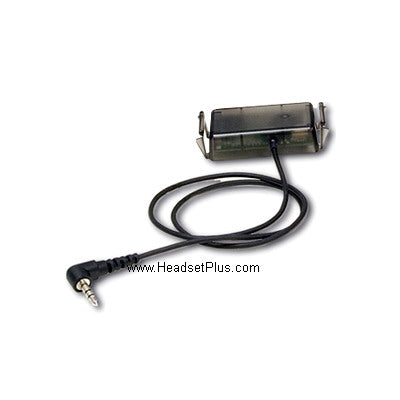
2006 — Plantronics offers a corded headset alternative with the M22 Vista Amplifier and the P251N Polaris SupraPlus, both becoming call-center top sellers. Both are discontinued — the Poly MDA524 is the current amplifier equivalent.
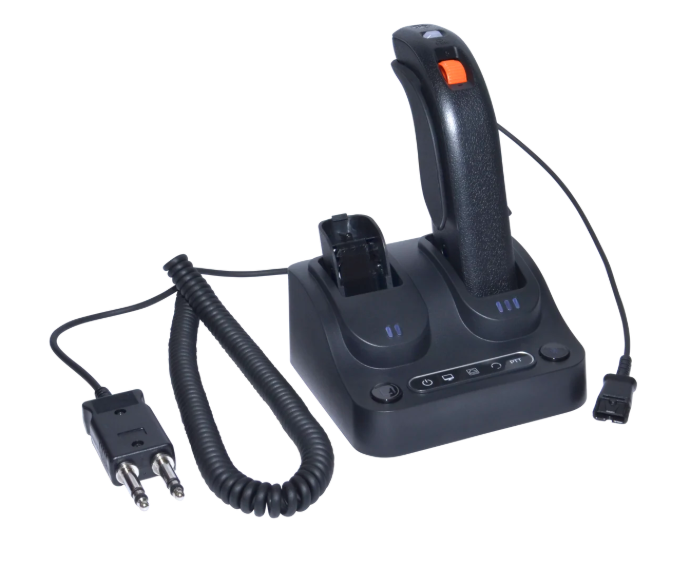
2007 — Dispatchers seeking a wireless Push-to-Talk option turn to the CA12CD PTT Adapter, which becomes popular for its console compatibility. Discontinued — see our CA22CD-SC vs CA22CD-DC comparison for the current dispatch adapter lineage.
2010 — With more devices needing headsets at once, Plantronics launches the Savi WO 201 — one of the first wireless headsets to connect a desk phone, computer, and mobile phone simultaneously. Discontinued; the Savi line has since evolved through several generations to the current Savi 7300 and 8400 series.
2011 — The Plantronics CS540 arrives as the next-generation, convertible successor to the CS50, quickly becoming a top seller. It remains one of Poly's best-selling wireless headsets today.
2014–2019: EncorePro, ANC, and the shift toward Poly
2014 — Noise cancellation improves across the new EncorePro family — the convertible HW540 and its siblings HW510 and HW520. The HW510 and HW520 are telecoil hearing-aid compatible, a first for users who need that support. All three remain current today.
2015 — Plantronics returns to corded USB with the Blackwire C725, adding active noise cancellation and smart sensors that answer a call when you put the headset on. Since succeeded by the current Blackwire 3320 and 8225.
2016 — The CA12CD-S PTT Adapter improves on encryption, range, and charging time over its predecessor. Since succeeded by the Poly CA22CD-SC.
2017 — Plantronics re-enters USB headsets with the Voyager 8200 UC, a boomless design pairing ANC with computer and Bluetooth mobile connectivity. Discontinued; the Poly Voyager Surround 80 is the current boomless equivalent.
2019 — The Savi 8240 Office arrives with extended range, faster charging, and improved sound — the first Savi headset with a red mute-status key. Discontinued; the current Savi 8400 series (8410, 8420, 8445) carries this line forward.
2020–2022: Poly and the HP acquisition
2020 — Plantronics officially completes its acquisition of Polycom, rebranding the combined company as Poly, and marks the moment with new video products including the Poly EagleEye Mini USB camera.
2021 — Poly launches the Savi 7310, a wireless headset connecting to any desk phone and computer via USB-A or USB-C, with 256-bit encryption and Acoustic Fence technology in the boom. Still current today.
2022 — The CA22CD-SC PTT Adapter arrives with a higher-encryption chip, succeeding the CA12CD-S. HP completes its acquisition of Poly (formerly Plantronics and Polycom) this same year, bringing 24/7 support and a renewed focus on remote and hybrid work — with no major changes to the product line beyond a shift from Poly to HP part numbers.
When was Plantronics founded?
Plantronics was founded in 1961 as Pacific Plantronics, started by two pilots in a garage in Santa Cruz, California, and incorporated on May 18, 1961, to design and manufacture specialized aircraft electronics.
Did Plantronics make the headset used during the moon landing?
Plantronics has long said that Neil Armstrong's first words from the lunar surface were transmitted through one of its headsets, and the company's lightweight headsets were used throughout NASA's Apollo program and later the space shuttle era — a well-documented, decades-long relationship. The exact technical chain from the lunar module to Earth involved multiple systems, but Plantronics' role supplying NASA's headset hardware during this period is accurate.
Is Plantronics still a separate company?
No. Plantronics acquired Polycom in 2018 and rebranded the combined company as Poly in 2019, and HP acquired Poly in 2022. Plantronics products are now sold under the HP Poly brand, though the underlying product lines — CS540, EncorePro, Savi — continue with the same lineage.
What replaced the original Plantronics CS50?
The Plantronics CS540, launched in 2011, is the direct successor to the CS50 and remains one of Poly's best-selling wireless headsets today. Several other 2000s-era Plantronics products in this timeline — the M22 amplifier, the Voyager 510S, the original CA12CD PTT adapter — have similarly been succeeded by current models.
From an aircraft-electronics startup helping astronauts talk to Earth, to the office headset on your desk today, the throughline is the same: lightweight design and reliable audio for people who talk for a living. See how that history compares to Poly's other half in our Plantronics, Poly & HP: who owns who guide, or browse the current range on the wired and wireless headsets collections.

Comments (0)