

























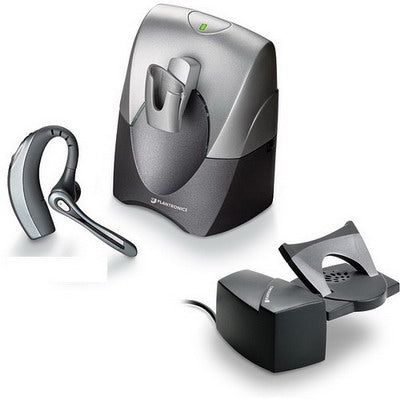
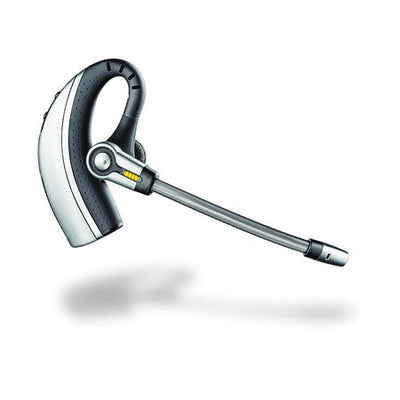
The Plantronics CS50 and CS55 were office-wireless workhorses for years, and plenty are still in service. Both are long discontinued now — replaced by the Plantronics CS540 — but if you've still got one running, most of the problems people hit are simple fixes that need no parts at all. This FAQ covers them, plus the one case where it's genuinely time to upgrade.
Key takeaways
- The CS50 (900 MHz) and CS55 (1.9 GHz DECT) are discontinued, both replaced by the Plantronics CS540.
- Neither uses Bluetooth — they use office DECT/digital wireless with far longer range (about 300 ft vs Bluetooth's 33 ft).
- One beep is low battery, two beeps is out of range, three rapid beeps is mute — the same across both models.
- Echo is a volume level set too high (factory defaults: ABCD switch = B, receive switch = 2); static is usually fixed by re-syncing the headset to the base.
- A worn battery on a headset this old usually means upgrading, since genuine replacement batteries are no longer available.
CS50 vs CS55: what's the difference?
The CS50 and CS55 headsets are physically identical and operate the same way — the difference is the base and the wireless frequency it uses.
| Plantronics CS50 | Plantronics CS55 | |
|---|---|---|
| Frequency | 900 MHz digital | 1.9 GHz DECT 6.0 |
| Talk time | Up to 8 hours | Up to 10 hours |
| Standby | Up to 40 hours | Up to 50 hours |
| Interference | Higher output, slightly better range | Designed to avoid Wi-Fi and wireless-device interference |
The CS55's 1.9 GHz DECT frequency was the more modern choice, specifically engineered not to clash with Wi-Fi, wireless keyboards, and other office electronics — which is why that same DECT technology carried forward into the CS540 that eventually replaced both. Neither is a Bluetooth headset; both use office wireless with roughly 300 feet of range, ten times what Bluetooth offered at the time.
Fixing common CS50/CS55 problems
Most CS50/CS55 faults are audio-level or connection issues with quick fixes. The beep codes are the same on both models: one beep every 10 seconds is a low battery (recharge on the base), two beeps means you've walked out of range (move closer), and three rapid beeps every 15 seconds means mute is on (press the mute control once). With an HL10 lifter connected, three rapid beeps instead signal an incoming call.
Echo or side tone: almost always a transmit level set too high. Lower the phone's volume first; if it persists, adjust the ABCD switch on the bottom of the base (A is lowest, D highest; factory default is B), fine-tune with the + and − buttons, and if needed move the configuration dial on the left side of the base — position 1 suits most phones (also the factory default). The receive-side 1234 switch on the back of the base defaults to 2, with 1 the highest setting and 4 the lowest; when adjusting it via the headset's volume wheel, a rising pitch means louder and a falling pitch means quieter.
Heavy static: usually clears with a re-sync of the headset to the base (steps below). Radio-station interference is a different issue — reposition the base away from other electronics and plug it directly into the wall rather than a power strip.
These are the same principles that carry through to the current generation, which our wireless headset beep-code guide covers for newer models.
CS50/CS55 battery: when to replace, when to upgrade
A CS50 or CS55 that won't turn on, won't fully charge, or gives far less than its rated talk time has a worn battery — the most common failure on a headset this age. Here's the honest situation in 2026.
Myth
My CS50/CS55 just needs a fresh battery and it's good as new.Reality
For a headset that's around two decades old, genuine Plantronics CS50/CS55 batteries are no longer stocked, and the headset itself is well past its service life. If the battery is the only issue you may find a compatible cell elsewhere, but for most owners a CS50 or CS55 that no longer holds a charge is the natural point to move to the Plantronics CS540 — the direct DECT successor, lighter, with a user-replaceable battery and current support.The CS540 uses the same 1.9 GHz DECT technology the CS55 pioneered, converts between three wearing styles, and remains one of the most popular office wireless headsets made — so it's a genuine upgrade rather than a sideways move. You can compare it against the current range on the wireless headset systems collection.
Re-syncing a replacement CS50/CS55 headset to the base
If you've paired a replacement headset with your base, or lost the connection, you'll need to re-subscribe them. First, check the IntelliStand switch on the right side of the base — it's ON in the bottom position (marked with a double dash) and OFF in the top position (a single dash); for re-subscribing, set it to OFF. Then:
- Return the headset to the charging base.
- Press and hold both the + and − buttons on the back of the base until the red light on the front flashes, then let go — it should keep flashing.
- Press the mute switch (the black wheel on top of the headset) straight down until a green light appears, then release; the light should stay on.
- Disconnect the AC power adapter from the base for 5 seconds, then reconnect it.
- Re-subscription is done when the base's red light is fully lit and the headset's green light disappears. Remove the headset and press the talk button to confirm the connection.
If it fails within two minutes, the headset returns to an un-subscribed state — try again, or call us at 877-999-3838 for help.
Performing a full system reset
If the headset or base runs into a fault condition that re-syncing or the fixes above don't resolve, a full system reset often clears it:
- Press and hold both the talk button and the mute control button on the headset together for 5 seconds.
- When the talk indicator light on the headset blinks, release both buttons.
- Press the talk button again.
- Next, reset the base unit by disconnecting the AC power adapter from its jack for 5 seconds, then reconnecting it.
The system reset is now complete. If the fault persists after this, the headset or base likely needs replacing rather than resetting again.
What's the difference between the Plantronics CS50 and CS55?
The Plantronics CS50 and CS55 headsets are identical, but the bases use different wireless frequencies. The CS50 runs on 900 MHz with up to 8 hours of talk time, while the CS55 runs on 1.9 GHz DECT with up to 10 hours and better resistance to Wi-Fi interference. Both are now discontinued and were replaced by the Plantronics CS540.
Are the Plantronics CS50 and CS55 discontinued?
Yes, both the CS50 and CS55 wireless headsets are discontinued, along with their genuine replacement batteries. The Plantronics CS540 is the direct successor, using the same DECT wireless technology with a lighter design and a user-replaceable battery. Existing CS50/CS55 units still work, but parts availability is now very limited.
Do the Plantronics CS50 and CS55 use Bluetooth?
No. The CS50 uses 900 MHz digital wireless and the CS55 uses 1.9 GHz DECT, both office wireless technologies with about 300 feet of range — roughly ten times Bluetooth's range at the time. They connect to a desk phone through the base, not to a mobile phone over Bluetooth.
Why is my CS50/CS55 beeping?
One beep every 10 seconds on a Plantronics CS50 or CS55 means a low battery — recharge it on the base. Two beeps means you've moved out of range, and three rapid beeps every 15 seconds means the microphone is muted, which you clear by pressing the mute control once. With an HL10 lifter connected, three rapid beeps signal an incoming call instead.
How do I fix an echo on my CS50/CS55?
An echo on a Plantronics CS50 or CS55 is caused by the transmit volume being set too high. Lower the phone's volume first, then adjust the ABCD switch on the bottom of the base (A is lowest, factory default is B), fine-tune with the + and − buttons, and if needed move the configuration dial on the left side, where position 1 (also the default) works for most phones.
What are the factory default settings on the CS50/CS55?
The transmit ABCD switch defaults to B, the receive 1234 switch defaults to 2, and the configuration dial defaults to position 1. These defaults suit most phone systems, though some phones require adjusting one or more of them for the clearest audio.
Should I replace my CS50/CS55 battery or upgrade?
Because genuine Plantronics CS50/CS55 batteries are no longer stocked and the headsets are around two decades old, a unit that won't hold a charge is usually best replaced rather than repaired. The Plantronics CS540 is the modern equivalent, with the same DECT wireless, a user-replaceable battery, and current support and warranty.
How do I perform a full system reset on my CS50/CS55?
Press and hold both the talk button and the mute control button on the headset for 5 seconds, releasing when the talk indicator light blinks, then press the talk button again. Disconnect the base's AC power adapter for 5 seconds and reconnect it to complete the reset. Try this if re-syncing alone doesn't resolve a fault.
If your CS50 or CS55 is still holding a charge, these fixes will keep it running — a re-sync, a level adjustment, or a full system reset solve the large majority of issues. But when the battery finally goes, that's the signal to move on: the Plantronics CS540 picks up exactly where the CS55 left off. Not sure which base you have, or what your options are? Call us at 877-999-3838.
Was this article helpful?
Thanks for letting us know.

Comments (0)