


















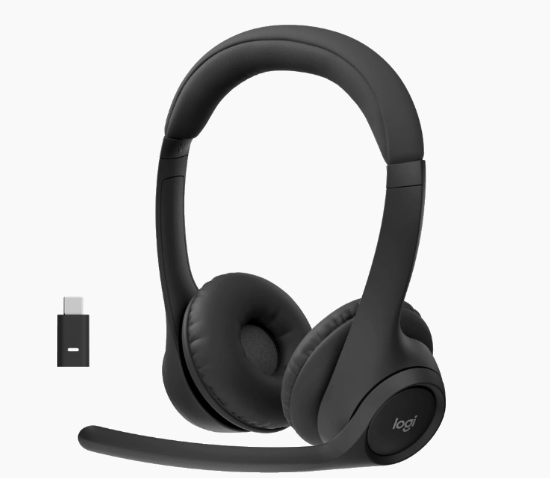








You bought a "noise-cancelling" headset, put it on expecting the office to fall quiet, and — nothing. The keyboard clatter, the colleague three desks over, the AC: all still there. That gap is what the noise-cancelling microphone vs active noise cancellation mix-up creates, and it sends more office headsets back than any other misunderstanding on the spec sheet.
The fix is one sentence: one feature cleans what your callers hear, the other quiets the room for you. They're separate systems aimed in opposite directions — and some headsets carry both.
Key takeaways
- A noise-cancelling microphone cleans your outbound audio for callers — it doesn't quiet the room for you.
- Active noise cancellation (ANC) quiets the room for the wearer by generating anti-noise. Opposite direction.
- ANC handles steady low-frequency hum (HVAC, fans) well but struggles with voices — the main noise in an open office.
- Passive isolation — the physical seal of the cushions and how much of your ear they cover — does more against voices than ANC.
- For a call center, the noise-cancelling mic is the feature that matters; ANC suits focus-heavy individual desks.
Noise-cancelling microphone vs active noise cancellation: the core difference
The difference between a noise-cancelling microphone and active noise cancellation comes down to direction: the microphone controls what leaves your headset, while ANC controls what reaches your ears. One protects your callers from your background; the other protects you from your surroundings.
Myth
A noise-cancelling headset makes the office go silent for me.Reality
Usually not. The "noise-cancelling" on most office headsets refers to the microphone, which cleans up what your callers hear — your own ears get no benefit from it at all. Silence for the wearer comes from active noise cancellation or a good passive seal, and even those quiet a steady hum far more completely than they quiet nearby voices.There's a third player most listings don't name: passive isolation, the plain physical block of the ear cushions. So you're really weighing three things, not two:
| Noise-cancelling mic | Active noise cancellation | Passive isolation | |
|---|---|---|---|
| Helps whom | Your callers | You, the wearer | You, the wearer |
| How it works | Multiple mics subtract background from your voice | Mics sample noise, speaker plays inverted anti-noise | Cushions and ear coverage physically block sound |
| Best against | Any background in your outgoing audio | Steady low-frequency hum | Higher-frequency sound, including voices |
| Needs power | Yes (built into headset) | Yes | No |
What does a noise-cancelling mic do?
A noise-cancelling mic reduces the background sound your callers hear by using two or more microphones — one aimed at your mouth, others sampling the room — so the headset can subtract the ambient noise and send mostly your voice. The café hum, the keyboard, the side conversation: filtered out of what the far end hears, while your own ears notice no change.
This is the feature on nearly every office and call-center headset, and it's why a corded model like the Jabra Biz 2300 puts so much engineering into the boom: an aerodynamic, perforated mic design that keeps your voice clean even when the floor around you is loud. If your problem is "people can't hear me over my background," this is the only feature you need.
What active noise cancellation actually does — and doesn't
Active noise cancellation quiets the room for you by sampling ambient sound with tiny microphones and playing an inverted "anti-noise" wave that flattens it before it reaches your ear. It's genuinely effective — within limits that matter a lot for an office.
Active noise cancellation (ANC): An electronic system that uses microphones to detect surrounding sound and a speaker to generate an opposite wave that cancels it, reducing what the wearer hears. It needs power and works best on constant, low-frequency noise.
Here's the catch the marketing skips: ANC shines on steady, low-frequency sound — HVAC drone, a fan, engine rumble — and struggles with sudden, irregular, higher-frequency sound. Which is to say, human voices. In an open-plan office where the dominant noise is people talking, ANC alone takes the edge off without delivering the silence the box implies.
Passive vs active noise cancellation: the seal does the heavy lifting on voices
Passive noise cancellation isn't electronic at all — it's the physical seal of the ear cushions and how much of your ear the headset covers. Against the high-frequency sound of human voices, that seal often outperforms ANC, which is the opposite of what most buyers assume.
How much passive isolation you actually get depends on whether you're wearing one earpiece or two. A single-ear headset leaves the other ear fully open to the room; a dual-ear model seals both. That trade — awareness versus isolation — is its own decision, and we break it down in monaural vs binaural headsets.
- One ear: more room awareness, less passive isolation against office noise
- Two ears: more passive isolation, better focus, less awareness of the floor
Do noise-cancelling headsets block background noise?
It depends which "noise-cancelling" you mean — and that's the whole trap. A noise-cancelling microphone blocks your background from your callers, not from you. To stop noise reaching your own ears, you need ANC, passive isolation, or both. And even then, the steady hum vanishes more completely than the voices nearby, so "block background noise" is never the absolute the word implies.
Noise-cancelling headset for the office vs the call center
For a call center, the noise-cancelling microphone is the feature that matters: agents need to be heard cleanly over a floor full of other calls, and that's purely an outbound problem. There's no single best noise-cancelling headset for call center use — it depends on your floor and phones — but a wired model with a strong noise-cancelling mic like the Jabra Biz 2300 covers the core need, and you can compare the field on the wired office headsets collection.
For focus-heavy individual work — a developer in an open-plan office, anyone who needs to think between calls — a noise-cancelling headset for the office benefits from ANC or a tighter passive seal on top of the mic. Some premium wired USB models, like the Jabra Evolve2 50, layer true ANC over the standard noise-cancelling mic. Noise control is one of the five decisions in our wider wired headset buying guide, alongside connection, ear count, comfort and certification.
What's the difference between a noise-cancelling microphone and active noise cancellation?
A noise-cancelling microphone and active noise cancellation work in opposite directions. The noise-cancelling microphone cleans your outgoing audio so callers don't hear your background, while active noise cancellation (ANC) quiets the room for you, the wearer, by generating anti-noise. Most office headsets include the microphone version, and ANC is a separate premium feature some models add on top.
Do noise-cancelling headsets block background noise?
Partly, and it depends which feature you mean. A noise-cancelling microphone blocks your background from your callers but not from your own ears, while ANC and passive isolation reduce what you hear. Even those work best on steady, low-frequency noise and only partly tame nearby voices, so no headset makes an office truly silent.
What does a noise-cancelling mic do?
A noise-cancelling mic reduces the background noise your callers hear. It uses two or more microphones — one aimed at your mouth and others sampling the room — so the headset can subtract ambient sound and transmit mostly your voice. It improves your outgoing audio only; it does nothing to quiet the room for the person wearing the headset.
What's the difference between passive and active noise cancellation in a headset?
Passive noise cancellation is the physical seal of the ear cushions and ear coverage, with no electronics, and it works well against higher-frequency sound like voices. Active noise cancellation is an electronic system that generates anti-noise and excels at steady low-frequency hum. In a passive vs active noise cancellation headset comparison, the passive seal often does more against office chatter than ANC does.
Which noise-cancelling headset is best for a call center?
For a call center, the best noise-cancelling headset is one with a strong noise-cancelling microphone, because the priority is being heard clearly over a busy floor. A wired model like the Jabra Biz 2300 handles that outbound noise well. ANC matters less on a call floor, since the goal is clean outgoing audio rather than silence for the agent.
Do I need a noise-cancelling microphone or active noise cancellation for my office?
Choose based on the direction of your problem. If callers struggle to hear you, you need the noise-cancelling microphone that most office headsets already include; if you struggle to concentrate, add active noise cancellation or stronger passive isolation. A noise-cancelling headset for the office often pairs both, but only the microphone is essential for clear calls.
Match the feature to the direction your noise runs. If your callers can't hear you over the room, you need a noise-cancelling microphone — the one nearly every office headset already has. If you can't concentrate over the room, you need ANC or a tighter passive seal, and against voices the seal usually wins. Decide which way your problem points, then shortlist on the wired office headsets collection or start from the top of the wired headset buying guide.