



























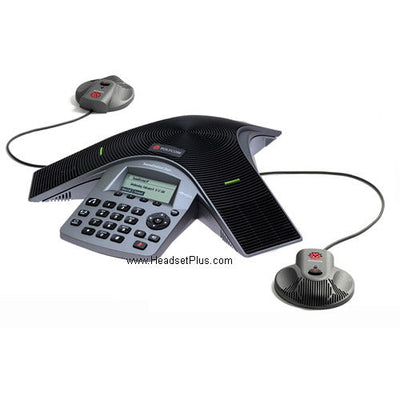
Polycom invented the three-armed conference phone, and for two decades the SoundStation was the default in every boardroom. That line has been succeeded by the Poly Trio — and the change matters, because the Trio is IP-based where the old SoundStation was analogue. Here's how the current range breaks down.
Key takeaways
- The Trio line replaced the SoundStation as Poly's current conference phone range.
- Trio 8300 for small rooms, 8500 for mid-size, 8800 for large rooms and boardrooms.
- All three are IP/SIP phones — check your line type before replacing an old analogue SoundStation.
- The 8800 expands into a video solution with the Trio Visual+ or VisualPro and an EagleEye camera.
- NoiseBlock automatically suppresses non-speech background noise across the range.
The one thing to check before you buy
If you're replacing an ageing SoundStation, this is the question that decides everything else.
Myth
A new conference phone will plug into the same line as my old SoundStation.Reality
Not necessarily. The classic SoundStation 2 was an analogue phone — it connected to a standard phone line. The current Trio range is IP/SIP, connecting over your network to an IP PBX or hosted VoIP service. If your meeting room still has an analogue line and no network drop, that's a wiring question to settle before ordering, not after. Call us with your setup and we'll confirm what fits.The Poly Trio range
Trio 8300 — small rooms and huddle spaces
The entry point, designed for flexibility in hybrid setups. It offers 360° microphone coverage and multiple connection options — IP, USB, Bluetooth, and Wi-Fi — so it can serve a room phone and a laptop-based meeting without rewiring. A backlit display rather than a touchscreen keeps the cost down.
Suits huddle rooms and small meeting spaces where a handful of people gather around one table.
Trio 8500 — mid-size meeting rooms
A three-microphone array with 360° pickup reaching roughly 14 feet, plus a 5-inch colour touchscreen that makes it operable without training — anyone who's used a smartphone can run it. HD Voice and NoiseBlock handle audio quality, and SIP support means it works across most VoIP platforms.
This is the volume-deployment model: the tier most organisations standardise on when fitting out several rooms.
Trio 8800 — large rooms, boardrooms, and video
The flagship, and more than a conference phone. It has the same 5-inch colour touch display and the longest microphone reach in the range, but its distinguishing feature is that it acts as a smart hub: connect a smartphone, tablet, or laptop and share content to a room display.
It's also the model that grows into video. Pair it with a Trio Visual+ or Trio VisualPro and a Poly EagleEye camera and the same phone anchors a full video conferencing setup — useful if you want audio now and video later without replacing the phone.
What NoiseBlock actually does
Poly's NoiseBlock automatically suppresses non-speech background noise — keyboard typing, paper shuffling, a fan, the HVAC — so it doesn't reach the far end of the call. It's the same principle as the Acoustic Fence technology in Poly's headsets: distinguish voice from everything else, and pass only the voice.
Worth being clear about what it isn't. NoiseBlock cleans up what your callers hear. It doesn't quieten the room for the people sitting in it.
Full-duplex: the difference from a cheap speakerphone
Full-duplex means both ends can talk and listen simultaneously, the way a normal conversation works. It's the clearest practical difference between a real conference phone and a budget speakerphone.
Plenty of inexpensive devices claim full-duplex while delivering something closer to half-duplex: the moment one person speaks, the other side clips or cuts out entirely. That's why meetings on cheap hardware feel like everyone is talking over each other — people can't hear that they've been cut off until they've already lost a sentence.
Sizing the room
Whichever model you choose, the underlying rule is the same: every participant should sit within 3–6 feet of a microphone. Room size, headcount, and table shape all follow from that — a long rectangular or U-shaped table can leave people at the ends outside pickup range even in a room the unit is nominally rated for.
Our conference phone selection guide covers sizing by room dimensions and table shape, and when a video bar makes more sense than a conference phone.
If you're running an older SoundStation
The SoundStation 2 is discontinued, though plenty are still in service. If yours is working, there's no urgency — our SoundStation 2 FAQ covers setup, expansion microphones, and troubleshooting for the installed base.
When it does need replacing, the Trio range is the successor, with the analogue-versus-IP question above as the first thing to resolve.
For the fuller story of how Polycom became Poly and then part of HP, see our Polycom history.
What replaced the Polycom SoundStation?
The Poly Trio range — the 8300 for small rooms, 8500 for mid-size, and 8800 for large rooms. The key difference is that the Trio line is IP/SIP-based, where the classic SoundStation 2 was analogue, so check your room's line type before replacing one.
Which Poly Trio model do I need?
The Trio 8300 suits huddle rooms and small meeting spaces, the 8500 mid-size rooms with its three-microphone array and 5-inch touchscreen, and the 8800 large rooms and boardrooms — where it also acts as a smart hub for content sharing and can expand into video.
Can a Poly Trio be used for video conferencing?
The Trio 8800 can. Paired with a Trio Visual+ or Trio VisualPro and a Poly EagleEye camera, it anchors a full video setup — so you can start with audio and add video later without replacing the phone.
What is Poly NoiseBlock?
Technology that automatically suppresses non-speech background noise — typing, paper, fans, air conditioning — so it doesn't reach the far end of the call. It improves what your callers hear rather than quietening the room for people in it.
Why does a proper conference phone sound better than a cheap speakerphone?
Full-duplex. A real conference phone lets both ends talk and listen at once, like a normal conversation. Budget speakerphones often claim full-duplex but clip or cut out the moment someone else speaks, which is why calls on cheap hardware feel like constant interruption.
The choice comes down to room size and whether video is on the roadmap — with the analogue-versus-IP question settled first if you're replacing an older unit. Browse the current range on our conference phones collection, or call our team at 877-999-3838 with your room dimensions and phone system and we'll match one.

Comments (0)