



























If you're comparing the Jabra Pro 920, 925, 930 and 935, here's the thing to know before anything else: the whole Pro 900 series is discontinued. Jabra retired the line, and the direct replacement is the Jabra Engage series. So this guide does two jobs — it decodes what each Pro 900 model actually was, and it tells you which current headset replaces yours.
The reason the four numbers confused everyone is that they were never a quality ladder. A higher number didn't mean a better headset. It meant a different connection — and once you see that, the whole series makes sense.
Key takeaways
- The Jabra Pro 900 series is discontinued — the current replacement line is the Jabra Engage series.
- The numbers meant connection type, not quality: 920/925 were desk-phone headsets, 930/935 were computer headsets.
- DECT models (920, 930) had longer range; Bluetooth models (925, 935) added mobile-device pairing.
- "Mono" covers one ear for room awareness; "Duo" covers both for noisier floors.
- The direct modern replacement is the Jabra Engage 65 SE, which connects to a desk phone and PC together.
Decoding the Jabra Pro 900 series: 920 vs 925 vs 930 vs 935
Every Pro 900 model answered two questions: what does it connect to, and how many ears does it cover. Read the numbers that way and the lineup is simple.
| Model | Wireless | Connects to | Replaced by |
|---|---|---|---|
| Pro 920 | DECT | Desk phone | Engage 65 SE |
| Pro 925 | Bluetooth | Desk phone only | Engage 65 SE |
| Pro 925 Dual | Bluetooth | Desk phone + mobile | Engage 65 SE |
| Pro 930 | DECT | Computer (USB) | Engage 65 SE / Engage 40 |
| Pro 935 | Bluetooth | Computer + mobile | Engage 65 SE |
Each of these also came in a mono or duo (binaural) version. That choice — one ear to stay aware of the floor, two ears to block a noisy room — hasn't changed across generations, and it's still the first decision worth making on any headset. We cover it in full in monaural vs binaural headsets.
The desk phone models: Pro 920 and Pro 925
The Pro 920 was the DECT workhorse — roughly 325 ft of range, 7–8 hours of talk time, fast charging (50% in about 50 minutes), and the ability to pair extra headsets to one base for multi-shift or conferencing. The Pro 925 swapped DECT for Bluetooth, trading range for a longer 12-hour talk time.
Myth
The Jabra Pro 925 is a Bluetooth headset, so it works with my cell phone.Reality
Not the standard Pro 925. Despite using Bluetooth, the base Pro 925 (part 925-15-508-185) connected only to a desk phone — its Bluetooth was just the wireless link to the base, not a way to pair a mobile. Only the Pro 925 Dual (925-15-508-205) added simultaneous pairing to a phone or tablet. The names looked nearly identical and the difference was everything, which is exactly why the "Dual" label mattered.The computer models: Pro 930 and Pro 935
The Pro 930 was essentially the Pro 920 pointed at a PC instead of a desk phone — DECT wireless, a USB base with a built-in ringer, and certification for the major UC platforms of its day. The Pro 935 was its Bluetooth counterpart, adding the ability to connect to a computer and a mobile device at once, with the Bluetooth radio in the headset itself so you could carry it away from the base.
What replaced the Jabra Pro 900 series?
The Jabra Engage series replaced the Pro 900 line, and it consolidated most of that confusing model spread into a single, more capable headset. Where you once had to pick between a desk-phone model and a computer model, the modern equivalent does both at once.
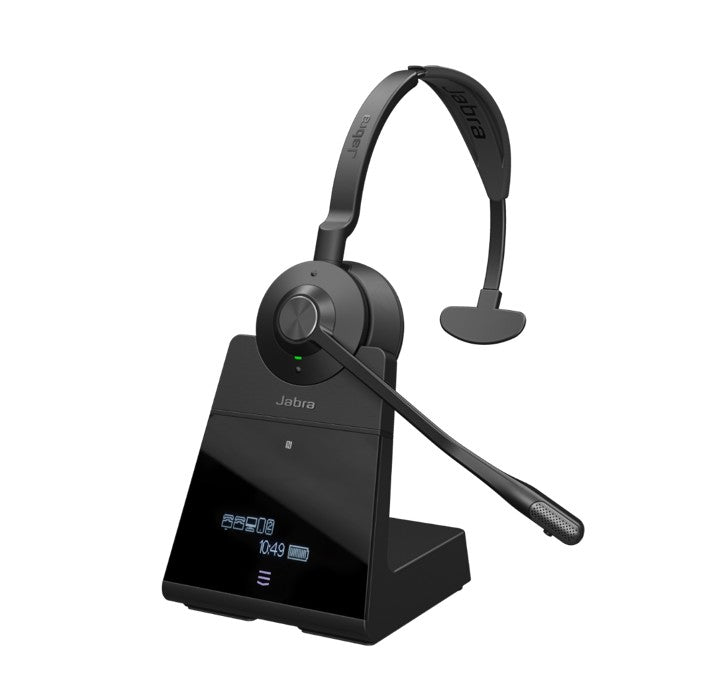
For almost every Pro 900 owner, the direct upgrade is the Jabra Engage 65 SE. It's DECT wireless like the 920 and 930, but connects to a desk phone and a computer simultaneously — replacing both halves of the old lineup — with far longer range and battery than any Pro 900 model managed, and it comes in mono, stereo, and convertible styles. It also lets far more headsets share an area without interference, which matters on a dense floor.
If your Pro 930 only ever connected to a computer and you don't need wireless roaming, the wired Jabra Engage 40 is a simpler, lower-cost route — a USB headset with the same noise-cancelling focus and no base to manage. Whether wireless is worth it over a wired connection at all is its own decision, and we weigh both sides in wired vs wireless headsets for call centers. The full current range sits on the wired office headsets collection, with the broader wired headset buying guide walking the whole decision.
Can I still get parts for a Jabra Pro 900 headset?
Some, yes — even though the headsets themselves are discontinued. If your Pro 900 still works and you just need to revive it, replacement headbands, earhooks, neckbands and ear cushions for the 900 series are still available, so a worn cushion or a snapped earhook doesn't mean a new headset. The spare headsets and charging bases, however, are discontinued, so a failed base or a dead headset unit is the point to upgrade.
Genuine 900-series parts live in the wireless headset parts collection. If the part you need is one of the discontinued ones, that's the signal it's time to look at the Engage 65 SE instead.
Is the Jabra Pro 900 series discontinued?
Yes, the entire Jabra Pro 900 series — the Pro 920, 925, 930 and 935 — is discontinued. Jabra replaced it with the Engage series, and the direct successor is the Jabra Engage 65 SE. Some replacement parts for the Pro 900 series are still available, but the headsets and charging bases themselves are no longer made.
What's the difference between the Jabra Pro 920, 925, 930 and 935?
The numbers encoded connection type. The Pro 920 was DECT wireless for a desk phone, the Pro 925 was Bluetooth for a desk phone (the 925 Dual added a mobile), the Pro 930 was DECT for a computer, and the Pro 935 was Bluetooth for a computer plus mobile. Each was available in mono (one ear) or duo (two ears).
What is the difference between the Jabra Pro 925 and Pro 925 Dual?
The standard Jabra Pro 925 connected only to a desk phone despite using Bluetooth, while the Pro 925 Dual added simultaneous pairing to a mobile phone or tablet. The names were almost identical but the capability was not, so the "Dual" designation was the one that signalled cell-phone connectivity. Both are now discontinued.
What replaced the Jabra Pro 920?
The Jabra Engage 65 SE replaced the Pro 920. It uses the same DECT wireless technology but connects to both a desk phone and a computer at the same time, with up to 490 ft of range and 13 hours of talk time — well beyond what the Pro 920 offered. It comes in mono, stereo and convertible wearing styles.
Can I still buy parts for my Jabra Pro 900 headset?
Some Jabra Pro 900 accessories remain available, including replacement headbands, earhooks, neckbands and ear cushions, so a worn part doesn't force a full replacement. However, the spare headsets and charging bases for the series are discontinued. If one of those has failed, upgrading to the Jabra Engage 65 SE is the practical path.
Which Jabra Engage model is best for a call center replacing a Pro 900?
For most call centers replacing a Pro 900 headset, the Jabra Engage 65 SE is the best fit, since it handles both desk phone and computer connections and supports many users in a dense space. If agents only use a computer and don't need to leave the desk, the wired Jabra Engage 40 is a simpler, lower-cost option. Mono suits agents who need room awareness; stereo suits noisier floors.
If you're here comparing Pro 900 models, you're almost certainly holding one that's showing its age — and the honest answer is that the comparison that matters now is old-versus-new, not 920-versus-925. Whichever Pro 900 you had, the Jabra Engage 65 SE covers what it did and more, or the wired Engage 40 if you've simplified to computer-only calls. Match the replacement to how you actually connect, and the upgrade is straightforward.

Comments (0)